
Services Details

  • Home
  • <
  • Services Details
thumb

CI/CD & DevOps Infrastructure

Transforming software delivery into an automated, predictable, and low-risk operational routine.
The ability to write modern software quickly has little commercial value if releasing that code into production is slow, manual, unpredictable, or fraught with operational risk.

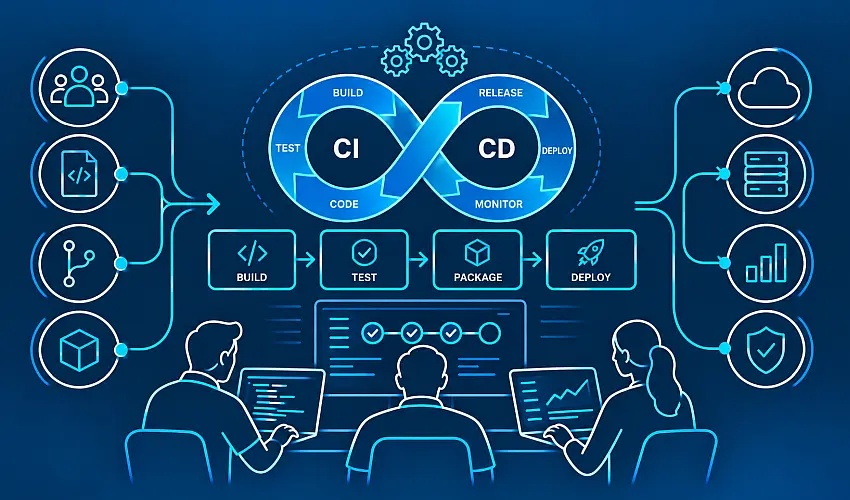
We bridge the historical divide between software engineering and system operations. By implementing automated deployment pipelines, version-controlled cloud infrastructure, comprehensive telemetry, and rapid recovery frameworks, we ensure your applications move from code commit to live production safely, consistently, and without disrupting your business operations.

Our Delivery Standard: The objective is never automation for its own sake. It is making every system modification safer, faster, observable, and easily reversible.

Why It Matters

Every manual deployment step introduces latency, human error, and operational fragility.
When environment configuration, server provisioning, security testing, and database migrations rely on manual checklists, software releases become high-stress corporate events. Engineering teams compensate with exhausting coordination meetings, extended deployment freezes, and a justified reluctance to release frequent updates.

Modern CI/CD and DevOps replace that friction with automated, observable, and immutable delivery pipelines. By breaking releases into smaller, automated increments, potential regressions are isolated in minutes rather than discovered during production incidents.

When modifying a live system becomes fundamentally safe, continuously improving that system becomes a competitive advantage.

Our Operational Framework

We engineer DevOps and CI/CD pipelines as first-class software products—embedding automation and governance directly into the development lifecycle from day one:

  • Infrastructure as Code (IaC): We eliminate configuration drift by provisioning and managing all environments through version-controlled, auditable templates (Terraform, AWS CloudFormation) rather than manual console tweaks.
  • Shift-Left DevSecOps: Security, dependency vulnerability scans, and static code quality gates are integrated directly into our pull-request triggers. Flaws are caught and blocked in local development, long before reaching staging or production.
  • Zero-Downtime Deployment Patterns: We configure modern deployment topologies—such as blue-green environments, canary releases, and rolling updates on containerized runtimes—ensuring production updates occur seamlessly without user interruption.
  • AI-Augmented Telemetry & Diagnostics: We leverage applied AI tooling within our pipeline diagnostics to monitor real-time build logs, detect anomalous telemetry trends, analyze latency spikes, and accelerate root-cause isolation when builds break or services fail.
  • Human Engineering Accountability: AI models assist with anomaly detection and automated linting, but our senior DevOps architects design the fail-safes, validate rollbacks, and maintain accountability for your system's uptime and compliance boundaries.

What We Engineer

  • Automated Continuous Integration (CI): Structuring reliable build pipelines (GitHub Actions, GitLab CI, Jenkins, AWS CodePipeline) that execute compile checks, automated unit test suites, and linting standards on every commit.
  • Continuous Delivery & Zero-Downtime Deployment (CD): Orchestrating automated, multi-environment promotion pipelines with automated smoke testing, manual approval gates, and seamless rollbacks to protect live revenue streams.
  • Infrastructure as Code (IaC) & Cloud Provisioning: Defining reproducible, auditable, and immutable cloud architectures on AWS using Terraform and container orchestration engines (Docker, AWS ECS Fargate, Kubernetes/EKS).
  • Environment & Secrets Governance: Maintaining strict parity across Development, Staging, and Production environments while securing production credentials, API keys, and certificates using centralized zero-trust secrets managers (AWS Secrets Manager, HashiCorp Vault).
  • Automated Quality & Vulnerability Gates (SAST/DAST): Embedding static application security testing, software composition analysis (SCA), and container vulnerability scanning directly into the pipeline to satisfy rigorous enterprise compliance audits.
  • Full-Stack Observability & Distributed Tracing: Engineering centralized logging, metric collection, and distributed tracing architectures (Prometheus, Grafana, Datadog, AWS CloudWatch, OpenTelemetry) to monitor real-time system health and ensure SLA compliance.
  • Automated Disaster Recovery & Rollback Engineering: Designing robust database snapshot routines, automated rollback triggers, and cross-region disaster recovery protocols to minimize Recovery Time Objectives (RTO) and Recovery Point Objectives (RPO).

The Outcome

  • Frictionless Release Cadence: Validated features, bug fixes, and security patches move from development to production in hours instead of weeks.
  • Elimination of Configuration Drift: Development, testing, staging, and production environments mirror each other precisely, eliminating "it worked on my machine" delays.
  • Dramatically Reduced Release Risk: Small, containerized, and automated changes minimize blast radius's, while automated rollbacks ensure continuous service availability.
  • Real-Time Operational Visibility: Engineering leadership and stakeholders gain actionable telemetry, log clarity, and uptime metrics across the entire application footprint.

From Risky Deployment Events to Routine Engineering.

DevOps succeeds when releasing software ceases to be a disruptive corporate ordeal and becomes an invisible, dependable part of everyday operations.

address1

Elevating Customer Experience.