
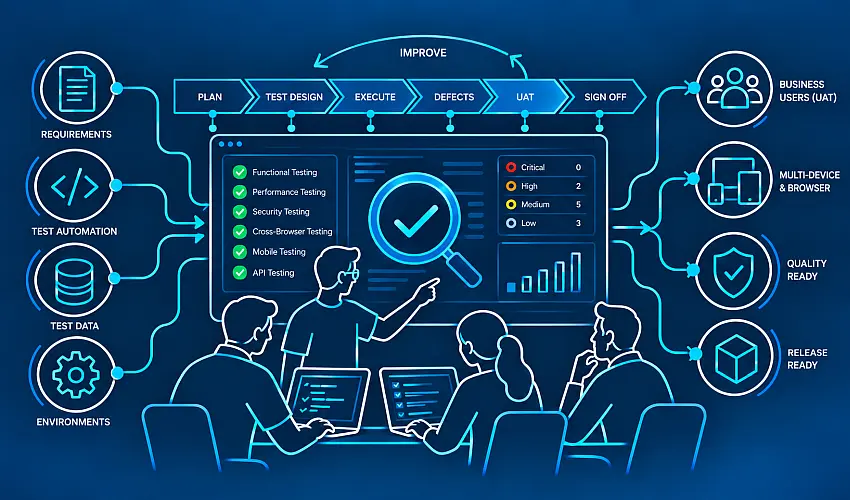
Quality Engineering & User Acceptance Testing (UAT)
Ensuring software delivers technical precision,
regulatory integrity, and measurable business value.
Working software is not necessarily successful software. An application can pass
isolated code inspections and unit checks while still failing commercially: the
underlying requirements were misinterpreted, high-concurrency race conditions were
missed, or the resulting workflows conflict with how real operational teams
function.
We embed quality engineering throughout the entire engineering lifecycle—from initial
requirements analysis and architectural stress-testing to automated regression suites,
structured User Acceptance Testing (UAT), and post-deployment validation.
Our Delivery Standard: Quality is never a gatekeeper stage tacked onto
the end of an engineering sprint. It is a shared, continuous discipline governing every
phase from conception to live operations.
Why It Matters
Traditional QA asks: Did we build the
system correctly against the specification?
Enterprise Quality Engineering must also ask: Did we build the right
solution to solve the business problem?
Validating software requires more than surfacing functional bugs in development
sandboxes. Requirements and user stories must be clear and testable. Acceptance criteria
must model real-world business permutations. Distributed microservices, third-party
payment gateways, and backend database syncs must execute reliably under enterprise
load.
Technical correctness is mandatory—yet it is only one dimension of overall software
quality. Technology succeeds only when code stability, user adoption, infrastructure
resilience, and commercial intent align.
Our Quality Framework
We establish test criteria during discovery and
systematically evaluate systems throughout every development sprint:
- Integrated Quality Collaboration: QA engineers work directly
alongside our business
analysts, system architects, and full-stack developers from day one, drafting test
matrices before engineering begins.
- Comprehensive Shift-Left Testing: We execute an integrated test
pyramid: automated
unit checks, API contract verification, end-to-end user journeys, and non-functional
performance benchmarks run automatically inside our CI/CD pipelines.
- Realistic Operational Simulation: We validate software against
sanitized,
production-scale datasets—testing edge cases, distributed network latencies, and
high-concurrency database queries.
- Structured, Business-Led UAT: We design structured UAT frameworks
that empower
actual end-users and client executives to evaluate software against real workflows,
ensuring organizational buy-in well before production cutover.
- AI-Augmented Coverage & Defect Modeling: We leverage modern AI
tools to accelerate
comprehensive test generation, analyze code paths for coverage gaps, synthesize
edge-case user personas, and isolate defect patterns across historical test runs.
- Human Judgment & Audit Ownership: AI expands test velocity and
diagnostic depth; our
experienced QA leadership validates business logic, confirms compliance
requirements, and oversees production sign-off.
What We Engineer
- Requirements Traceability & Test Matrix Design: Auditing functional
requirements to
ensure clear, unambiguous acceptance criteria, complete scenario mapping, and
end-to-end traceability from ticket to test result.
- Automated Regression Suites: Designing maintainable, scalable
automation frameworks
(Playwright, Cypress, Selenium) that run continuously in CI/CD pipelines to protect
core features as codebases evolve.
- API & Microservice Integration Testing: Validating payload schemas,
authentication
tokens, rate limits, and asynchronous message queues (Postman/Newman, REST Assured,
Pact) across distributed architectures.
- Data Integrity & Transactional Testing: Verifying multi-system data
synchronization,
database concurrency, and split-ledger operations across payment gateways (Stripe
Connect) and automated tax compliance engines (Avalara, VATsense).
- Performance, Load & Stress Testing: Simulating high-traffic
operational bursts and
evaluating system degradation thresholds (k6, Apache JMeter, Gatling) to verify
system responsiveness under peak enterprise loads.
- Exploratory & Edge-Case Testing: Conducting structured exploratory
sessions to
uncover complex UI quirks, boundary defects, and cross-browser anomalies that
automated scripts fail to detect.
- Structured User Acceptance Testing (UAT) Governance: Facilitating
business
stakeholder onboarding, providing guided test scripts, tracking user acceptance
sign-offs, and running triage cadences during pre-release validation.
- Production Readiness & Go/No-Go Gateways: Synthesizing technical
metrics,
code-coverage logs (SonarQube), security vulnerability reports, and UAT sign-offs
into decisive executive release recommendations.
The Outcome
- The Right Solution Built: The delivered application directly
reflects documented
business needs, eliminating costly post-launch rework.
- The Solution Built Right: Software operates reliably, securely, and
consistently
under real-world enterprise conditions.
- Frictionless User Adoption: Workflows match real operational
practices, reducing
user onboarding friction and support ticket volume.
- Continuous Production Insight: Quality verification extends into
live production via
telemetry, incident logs, and user support metrics—feeding actionable insights
directly into ongoing system optimization.
From Technical Specifications to Operational Confidence.
Quality engineering succeeds when we demonstrate not merely
that the software functions, but that what we delivered works reliably for the business
and the people it was built to serve.